Needs for Curriculum Innovation
The landscape of Higher Education is shifting from “Teacher-Centric” (what did I teach?) to “Student-Centric” (what did they learn?). This shift is driven by industry demands for employable skills, global mobility of graduates, and accreditation mandates. Traditional models often prioritize syllabus coverage over competency mastery, leading to significant gaps between graduate capabilities and employer expectations.
Furthermore, the rapid pace of technological advancement means that static content quickly becomes obsolete. An outcome-based approach focuses on enduring competencies—critical thinking, problem-solving, and adaptability—that remain relevant regardless of changing tools and technologies. To realise the impact of OBE it is imperative the curriculum needs to be overhauled. Through the framework we help the IHL/Universities to align the best practices in the academic curriculum to develop graduates for the WORLD.
Our Approach
Aligned with NEP 2020 and OBE
Adopted into existing academic structures (credits, capstones, internships)
Enabled industry-linked, community-based problem solving
Produce evidence for NAAC, NBA, and NIRF reporting
Enhances institutional differentiation and brand value
Execution Strategy
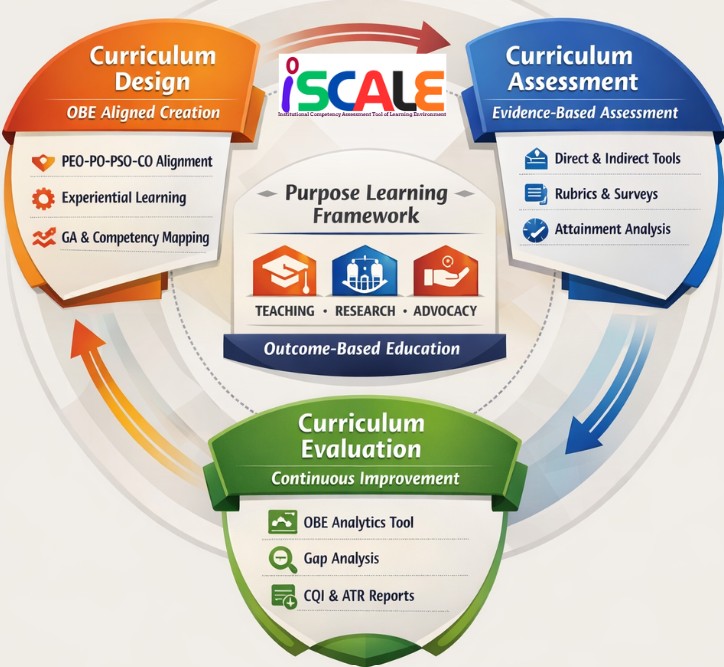
H1: Design Alignment focuses on systematic curriculum structuring that translates institutional vision and societal needs into clear, assessable learning outcomes.
Outcome Definition: PEOs, POs, PSOs, and Course Outcomes (COs).
Mapping Matrices: CO-PO articulation matrix and correlation levels.
Structure: Credits, L-T-P, and elective choices.
NEP Alignment: Flexibility, skill integration, experiential learning
Competency Framework: WP, CPS, Engineering Activities
H2: Curriculum Assessment Alignment ensures robust assessment mechanisms that accurately measure student attainment of learning outcomes.
Blueprinting: Aligning questions to Bloom’s levels and COs.
Rubrics: Analytic criteria for projects and labs.
Methods: Balance of direct (exams) and indirect (surveys) tools.
Continuous Assessment: Assignments, quizzes, labs, projects
End-Semester Design: Complex problem solving, engineering activities
Attainment Calculation: CO and PO with 11 POs
H3: Curriculum Evaluation Alignment close the OBE loop by evaluating curriculum effectiveness and enabling systematic improvement using digital and analytical tools.
Attainment Calculation: Quantitative outcome measurement.
Gap Analysis: Identifying weak areas and root causes.
Closing the Loop: Action Taken Reports (ATR) and CQI.
NBA SAR 2025: Evidence preparation, accreditation readiness
Root Cause Analysis: Low attainment identification
MADE Teaching Research Advocacy (TRA) Academy
Background
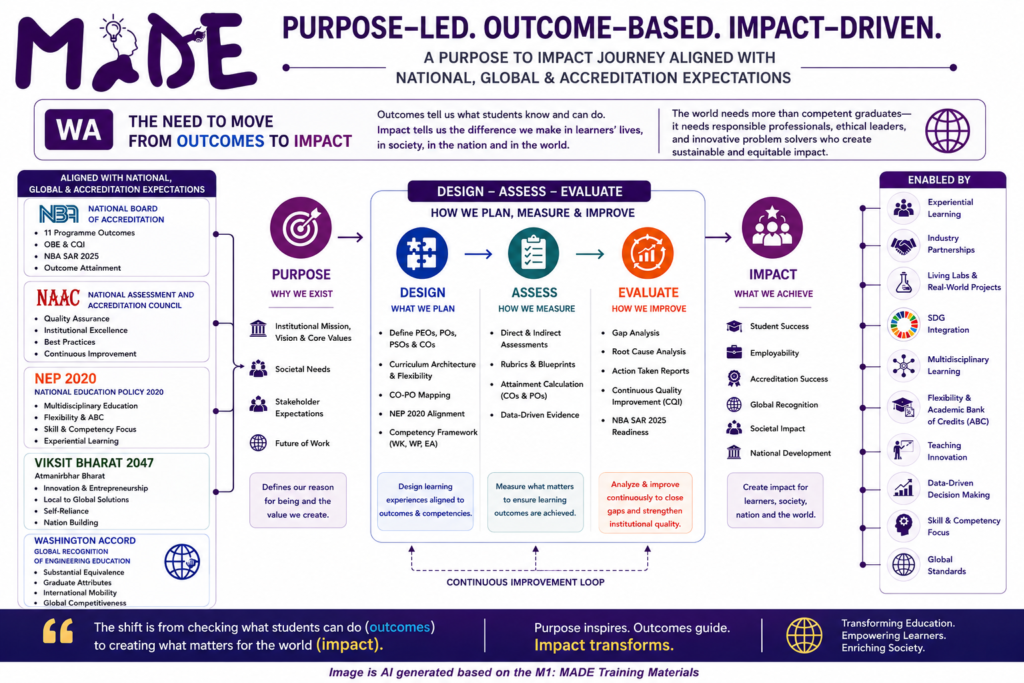
Universities and IHLs today are under increasing pressure to demonstrate not only academic excellence, but also graduate employability, societal impact, accreditation readiness, and measurable learning outcomes. The challenge is not a lack of effort but on alignment. Many institutions have strong visions, robust curricula, and dedicated faculty, yet often struggle to connect institutional purpose with measurable impact in a systematic and evidence-based manner. The MADE TRA Framework was developed to bridge that gap.
First, we establish Purpose by aligning learning with institutional mission, graduate attributes, societal needs, future workforce requirements, and stakeholder expectations. Second, we focus on Design by translating these aspirations into curriculum architecture, competency frameworks, learning outcomes, and meaningful learning experiences. Third, we strengthen Assessment through structured measurement tools, rubrics, blueprinting, continuous assessment, and attainment tracking to ensure that learning can be measured effectively. Fourth, we support evaluation through data-driven quality improvement, gap analysis, root-cause identification, and continuous enhancement processes. Finally, we demonstrate Impact by providing evidence of student success, employability, accreditation readiness, institutional performance, and societal contribution.
What makes MADE different is that we begin with the question “Why?” before moving to “How?” and ultimately proving “What?” This creates a transparent and measurable pathway linking institutional vision, academic delivery, quality assurance, and stakeholder outcomes. The result is an institution that is better positioned for accreditation, stronger graduate outcomes, improved decision-making, enhanced global competitiveness, and greater societal relevance.
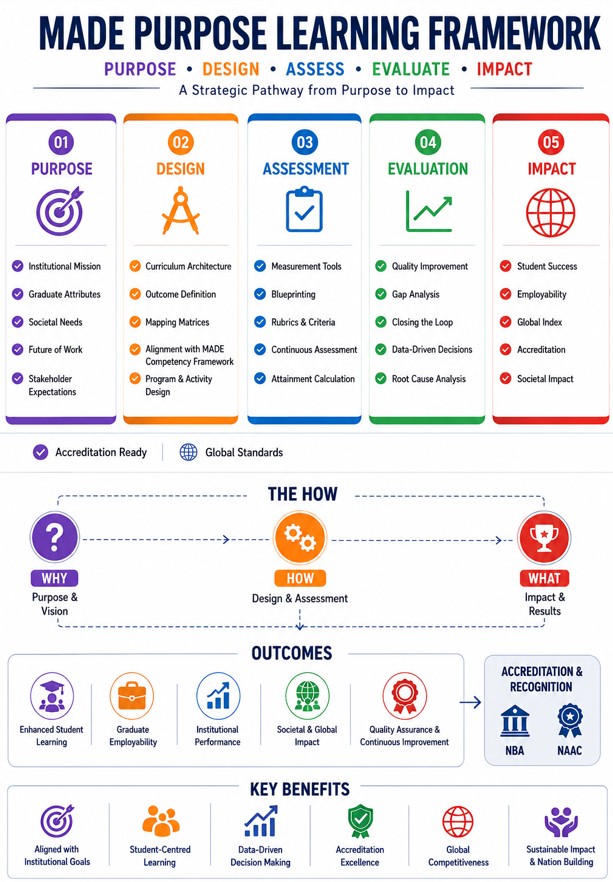
We believe quality education should not be measured only by what is taught, but by the impact it creates. We would welcome the opportunity to discuss how the MADE Purpose Learning Framework support your institution’s strategic priorities and help create a sustainable culture of continuous improvement and measurable impact.
Your Needs
If every programme in your university could clearly demonstrate how institutional purpose translates into graduate success, employability, accreditation excellence, and societal impact, what would that mean for your institution?
Our Solution
The MADE Purpose Learning Framework transforms institutional vision into measurable impact by aligning purpose, curriculum, assessment, quality assurance, and outcomes within a single evidence-based framework.
MADE TRA Academy Programmes
MADE V1: Curriculum Innovation for Future-Ready Education: Applying Design Thinking to OBE and Industry Alignment (5 days)
Module 1: Purpose Driven Execution Strategies
Purpose Learning Framework (alignment with SDG and WA) Tools Techniques, PEO-PO-CO alignments with Mission, Vision
Module 2: Outcomes Based Education Adoption
Curriculum Design, Bloom’s Taxonomy, CO-PO Alignment Mapping Scale
3-2-1 significance, Alignment and Design
WK-WP-EA Framework and Alignment
Question Paper Design, Assessment, Alignment and Result Analysis
Module 3: Impact measurments, Data analytics for Academic transformation
Constructive Alignment for Academic Transformation
Research and Professional Practice Profiling
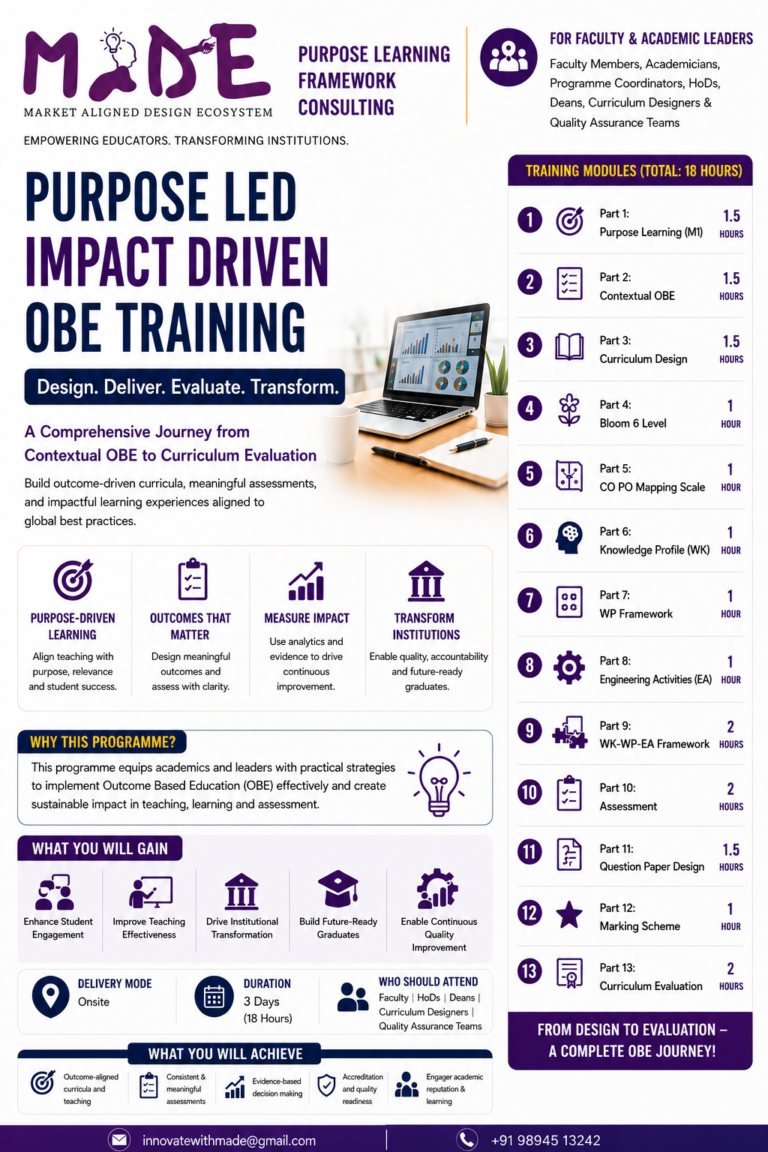
MADE 101 Purpose Learning Impact Driven OBE Alignment (3 days)
Purpose Learning
Contextual OBE
Curriculum Design
Bloom’s Taxonomy
CO PO Mapping Scale
Knowledge Profile
WP Framework
Engineering Activities
WK-WP-EA Framework
Assessment
Question Paper Design
Marking Scheme
Curriculum Evaluation
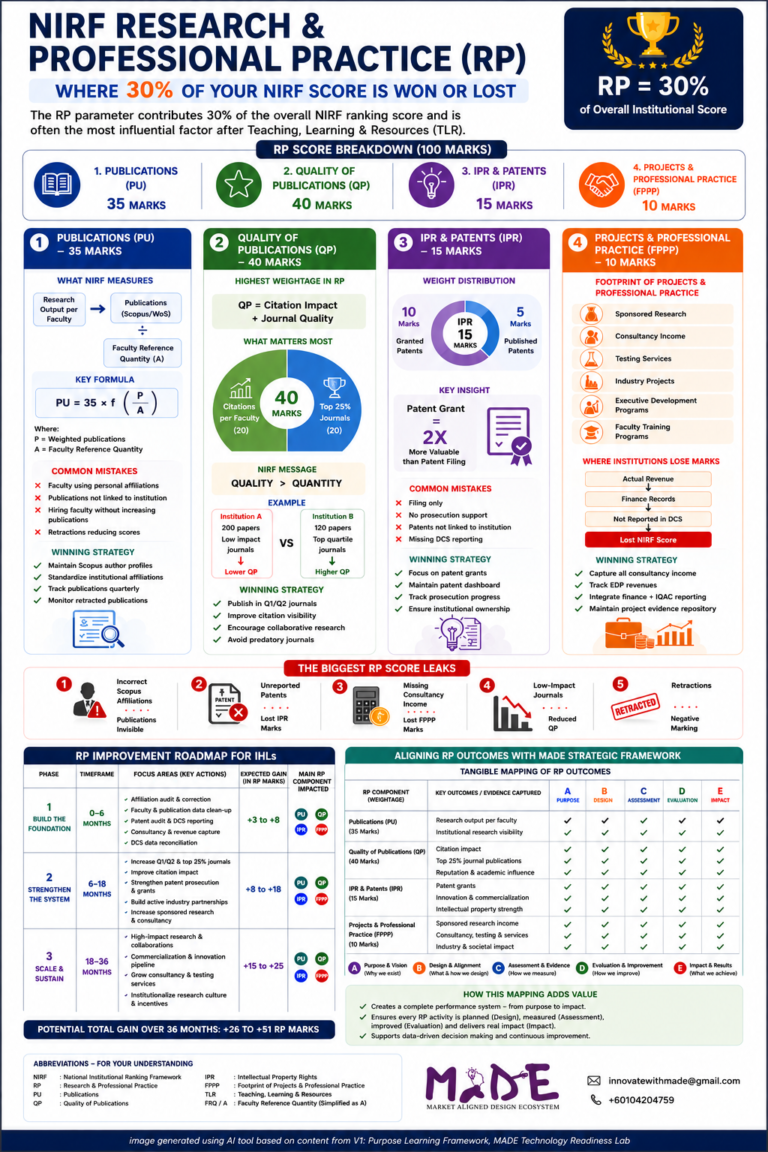
MADE102 Execution Strategies for NIRF Professional Practice (RP) (3 days)
NIRF RP Framework
Decoding the RP Scorecard
Publication Performance (PU)
Quality of Publications (QP)
Intellectual Property and Patent Outcomes (IPR)
Projects & Professional Practice (PPP)
Managing Research Data, Evidence and Compliance
Fixing RP Score Leaks
3-6-9 RP Improvement Roadmap
Execution Strategies
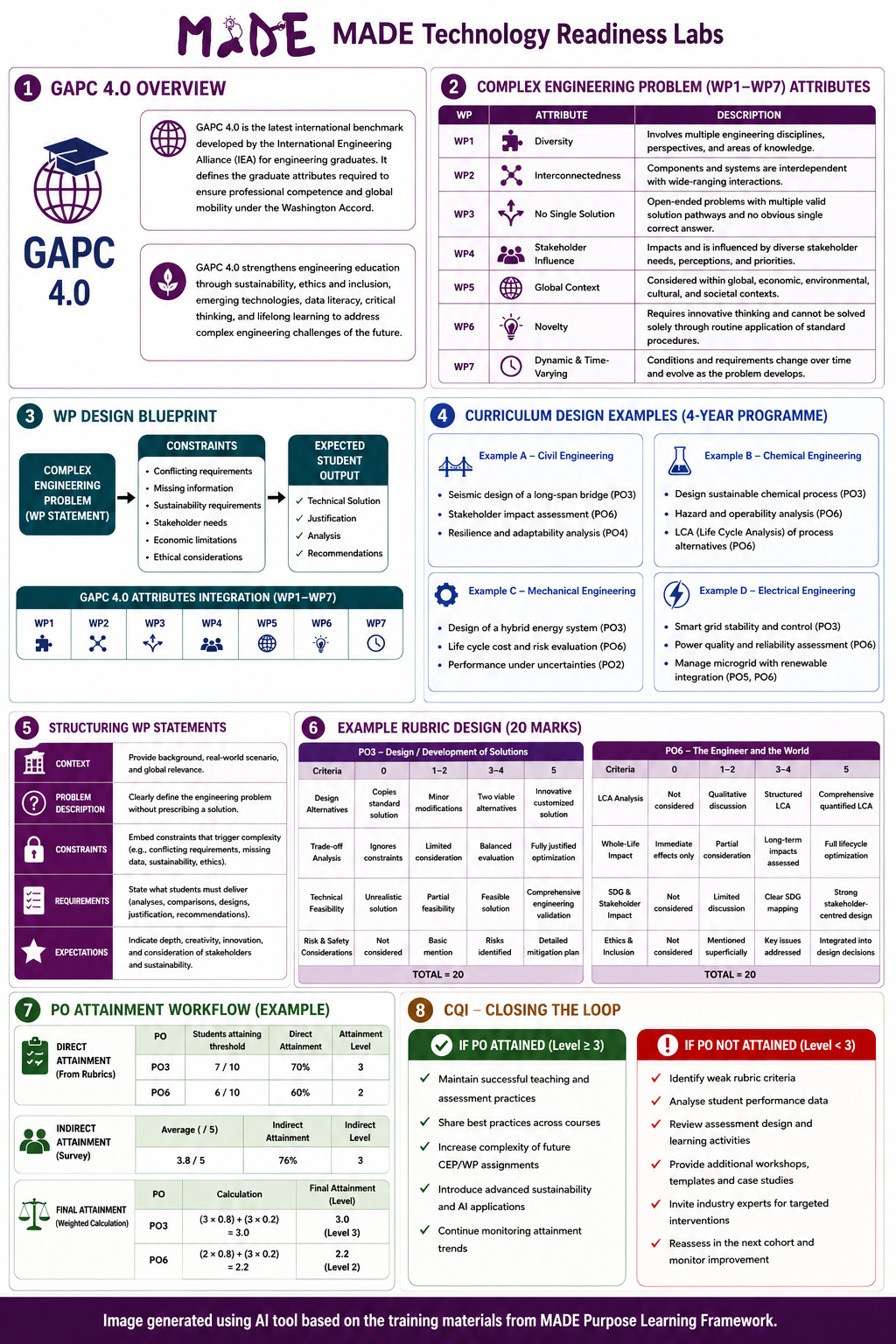
MADE 103 Graduate Attributes and Professional Competencies (3 days)
GAPC 4.0 and the Washington Accord
Understanding Complex Engineering Problems (CEP)
Designing Effective WP/CEP Statements
Aligning Curriculum with GAPC 4.0 Graduate Attributes
Designing CEP-Based Learning and Assessment Activities
Developing Rubrics for PO Assessment
Measuring Programme Outcome (PO) Attainment
Continuous Quality Improvement (CQI): Closing the Loop
Workshop Activity – Designing a CEP Assessment Package
MADE Engagement Reflections
My biggest learning is clear understanding of rubrics / CO modifications to moderate CO attainment. I would strongly recommend this programme to academics.
Prof. Hannah Jebarani D
VELTECH Chennai India
ERIC principle is my biggest learning and i will apply in my classroom projects and assingments. A Big 5 for the trainer.
Prof. Vijayakumar
KIOT Salem India
How design thinking is useful in accelerating the idea to the market in a easy way is my learning. Fabulaous trainer and best value for my time invested.
Prof. Abdul Bari
KSR Tiruchengode India